Creating More Diversity in the Publishing Industry
Creating More Diversity in the Publishing Industry
The story so far, and what’s needed to bring publishing into the 21st century
Read Time – 8 minutes.
When I got my first big publishing deal 10 years ago, it was obviously a major life event. With it came a whole host of speaking opportunities, many of which were a big step up for me. The first was in London, and as I was feeling slightly nervous, I did what any self-respecting author in my industry did at that time. I practice my presentation over and over in my head while picturing the audience in front of me. Because it was London, I pictured an audience that matched my experience of the city. In my mind I saw a sea of black, brown, white and Asian faces. I pictured women in hijabs, saris and bright African prints. Alongside men in suits, or bring colored fashions, I also saw Sikhs in turbans too. This was the London I had known and loved since childhood, and the one I expected to see in the audience at my first major speaking event.
When I walked on stage, I literally froze for a second. Not from fear, but more from shock at the picture before me, which was vastly different from the one I had painted in my mind. Before me sat a sea of white faces, with barely a person of color in sight.
I gave my presentation, and although I was happy with my performance, something wasn’t sitting right. I needed to know why an event of this nature was not appealing to people of color and why so few had been drawn to attend. I wasn’t a stranger to this kind of question. Working as a teacher for teenagers with severe behavioral problems in my previous career, I had developed a sharp eye for racial exclusion, and other sensitivities around equality and equity. And as I asked myself the question the answer was already obvious. Representation. Sure enough, as I glanced down the list of other author-speakers, this suspicion was confirmed. Every face—without exception—was also white.
For the decade that followed, calling out this blindspot became a passion of mine. I wanted to find a way, not just to highlight this gap, but to begin closing it. Over the years, as I developed my publishing consulting and ghostwriting company, I saw more and more that those gaps were present not only because authors of color (alongside LGBTQ+ authors, and those with disabilities) were not getting as many publishing deals as white authors, but that the problem was deeper, and the issue stemmed from a lack of representation in the publishing industry itself.
Fast-forward 10 years where I recently met Sacha Chadwick—a young woman of color who is currently undertaking a masters program in publishing at Washington University. We realized that we shared a similar passion, and when I discovered that Sacha had been gathering data and doing research on the lack of diversity and representation in the publishing industry, we decided to join forces to share my experience with her knowledge, to bring you an article on the story so far, and what needs to happen for that story to evolve.
The Current Face of the Industry
“When I attended grad school I quickly realized that the publishing industry is made up largely of white, cis gender, able bodied females,” Chadwick told me. She also shared how she’d seen this represented in audiences too, where she’d go to book signings, and had a similar experience to the one I had a decade ago. Even in a multicultural city such as New York, everyone there would mostly be white.
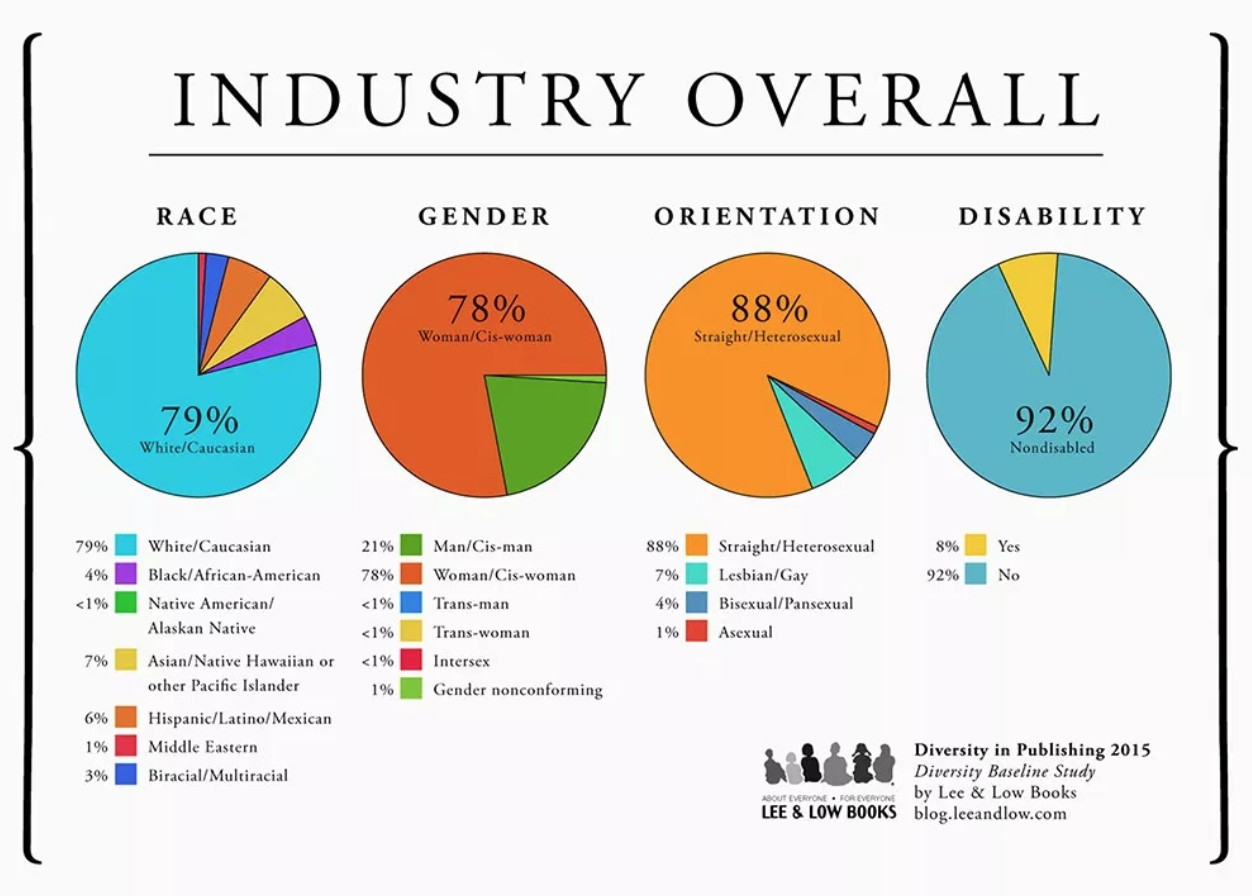
“If we look at the 2015 Lee and Low Diversity in Publishing data we can begin to see why,” Chadwick shared. The data shows that as of 2015, 79% of the publishing industry is white/caucasian, 78% are women/cis women, 88% are straight/heterosexual, and 92% are non-disabled. From this picture we begin to understand the imbalance in representation in the industry as a whole.
Breaking It Down
In order to take a deep dive into this issue, we need to recognize that it is multi-dimensional. Some of the key issues that have been prevalent over the years are that:
-
- Because the publishing industry itself is largely comprised of white, hetrosexual, non-disabled women.
- This leads to people of color, LGBTQ+ and disabled authors not getting the kind of equality of opportunities that their valuable work deserves.
- It also leads to another highly sensitive issue that is less often discussed but also highly prevalent. When people of color do get publishing deals, their voices are often edited to sound more white.
We’re going to break down each of these issues in this article and then suggest what needs to happen in the publishing industry as a whole for these statistics to change.
1 – Changing the Face of the Industry
“Undertaking a masters in publishing, I quickly began to realize that people of color (POC) were not feeling welcomed in the publishing industry,” Chadwick shared. “When there are such a small number of POC in any industry, it can lead to familiar feelings of isolation or not feeling welcomed. So the problem continues to perpetuate.”
“The other issue,” she continued, “is that with diversity being highlighted as a buzzword, often companies will carry out a ‘token hire’. Yet we need to ensure that diversity isn’t just a trend that it is being satisfied by ticking a box to say that it is done. We need publishing companies to be addressing the intrinsic biases they have been built upon, so that diversity becomes the norm rather than the following of a trend.”
She finished by highlighting, “Often POC, and other minority groups, don’t even realize that publishing is a possible career choice. They need to be given the opportunity to explore and pursue such interests, and the publishing industry itself needs to take responsibility for ensuring that this happens.”
When we have more diversity in the industry itself, it leads to more diverse opportunities for authors of color, authors with disabilities, and LGBTQ+ authors to be considered for publishing deals.

2 – Creating More Diverse Publishing Opportunities
A couple of weeks ago a good friend of mine came to me with an issue that sounded all too familiar. He works at a tech conference company, one that has prided itself on celebrating diversity in the industry and has a high volume of POC among both its staff and presenters. He was working with a colleague on picking out female speakers that were “breaking the glass ceiling” in tech. His colleague was picking the list and his job was to refine it. But when the list came through, he was shocked to find that his colleague (who was a white, blond haired American) had picked a list of women that looked exactly like her. As he is brown, he was quick to see the blindspot. “I doubt that she realizes, but she picked 7 versions of herself,” he told me. He rectified the issue and the speaker list became way more diverse. But this is precisely the problem that we have faced in the publishing industry so far. If the majority of the people who are selecting manuscripts for publishing are white, able bodied and heterosexual, there is likely to be an unconscious bias towards selecting authors who feel or sound familiar.
This leads to our next issue. How voices of color are interpreted through a white lens.
3 – Honoring Voices of Color
When Candice got her publishing deal it was a day of celebration. She’d had all the pieces in place—an extremely well written and researched book, a large platform of engaged followers, and even a possible TV show on the table. We’d worked hard to get her a deal and were both super happy when it came through. But just over six months later when her book had returned from the editors she called me, sounding defeated.
“They edited the blackness out of my voice,” she told me. “I sound like Mrs, Hargreaves, my white, third grade English teacher.” And sure enough, when she sent me the edits to review, her book and been sterilized into a white, generic voice.
So here’s the challenge—and it’s one that every author will face—regardless of their ethnicity. Because of publishing conventions, there will often be a kind of battle between the author and the publishers, especially if the author writes with a more informal tone. I’ve worked with many authors to bridge this gap and formalize their writing so that it fits with more traditional publishing conventions. But—and this is a very big BUT—this is a totally separate issue from a white editor steaming through a manuscript written by a person of color and “Anglifying” it, so it’s content is more familiar to a white eye.
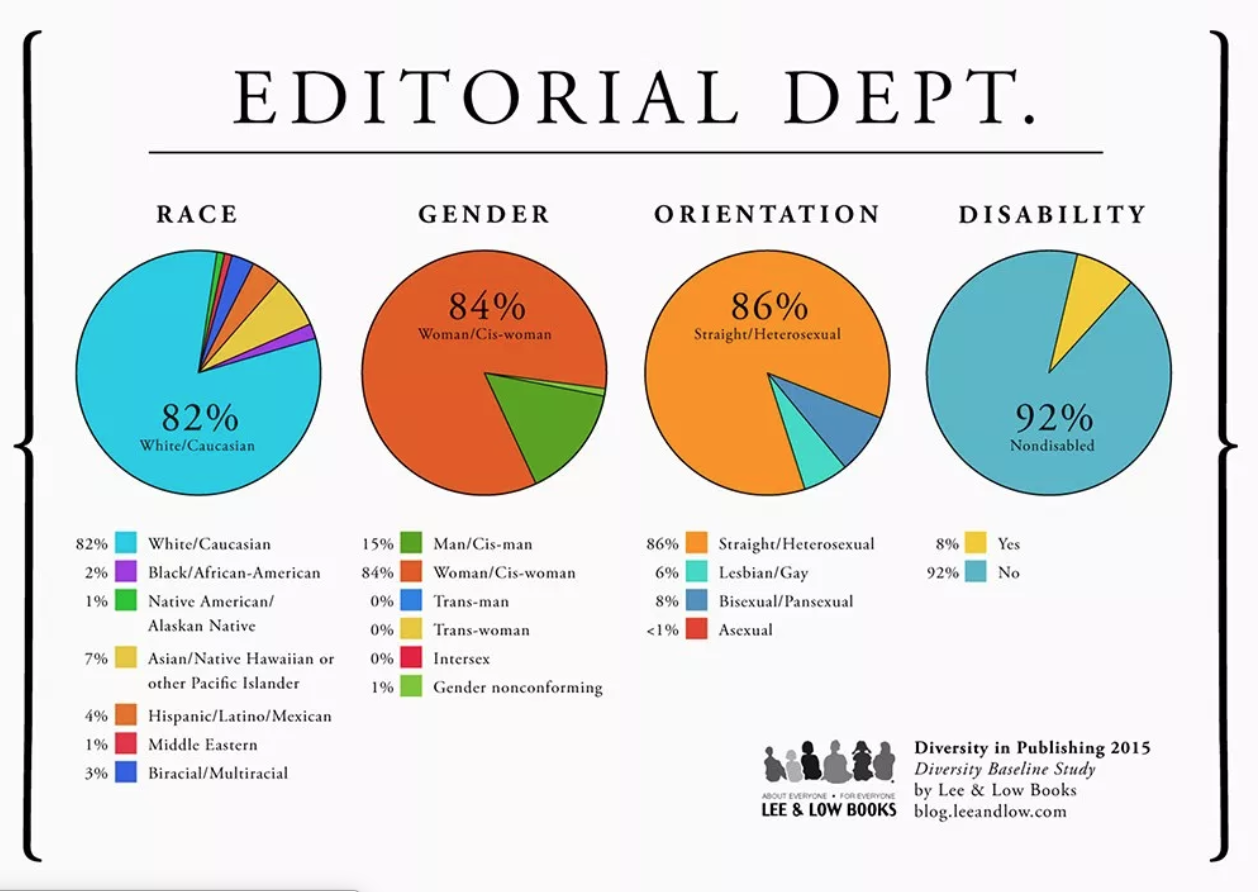
Highlighting this issue with Chadwick, it’s easy to see the root of this problem. “If we go back to the 2015 Lee and Low Diversity in Publishing Survey, we can see that in the editorial department, 82% of editors are white, 84% percent women/cis-women, 86% straight/heterosexual, 92% non-disabled.” So basically, it’s not just in those who are choosing the publishing deals that create the issue, but when those deals are underway, they are still being edited through a white lens.
Paving the Way Forward
Some publishing houses have been leading the way on addressing these issues. Houses such as The New Press are at the forefront of these changes. In an article in Publishers Weekly we learn that:
“The New Press was […] founded with a mandate to embrace diversity both in its publishing lists and in its staff. In an industry with a continuing dearth of minority representation at every level, the New Press strives to practice what it preaches.”
The New Press began with a staff of five in 1992, and by 2017 had 28 employees, 39% of which were POC.
“The house’s 25-year-old diversity-focused internship program is one of the industry’s longest running and most successful; it has trained and sent more than 550 former interns into jobs in book and magazine publishing, including in-house.”
What The New Press have modeled, shows the rest of the publishing industry that change is possible. In order for that to occur, we need to:
-
- Make more programs that will open doors and point minorities in the right direction
- Give opportunities to more diverse voices (creating more positions within the industry, as well as publishing opportunities)
- Ensure that voices of color are edited with respect for cultural differences
- Gear departments towards making publishing houses more diverse, and ensure that there are strategies in place to retain those employees
- Implement diversity training by POC in the publishing industry, so diversity becomes a norm and not just a trend.
Books are one of our most valuable commodities for our social evolution. Ensuring that books reflect the many dimensions and faces of our society is an essential component for our social development in the 21st century.
(SCROLL DOWN TO THE BOTTOM OF THE PAGE FOR FURTHER RESEARCH AND STUDY.)
This Article was Written and Compiled by Sasha Allenby @Equality Hive

For the past decade, Sasha Allenby has been a ghostwriter for some of the greatest thought-leaders of our time. Her journey started when she co-authored a bestselling book that was published in 15 languages worldwide by industry giants, Hay House. Since then, Sasha has written over 30 books for global change agents. Following the events of the last couple of years, she turned her skill set to crafting social messages. Her latest book Catalyst: Speaking, writing and leading for social evolution supports thought leaders to craft dynamic messages that contribute to change.
This Article was Researched and Contributed to by Sacha Chadwick
Sacha Chadwick is a first year graduate student studying Publishing at George Washington University. When she is not studying for school, she focuses her time educating others on the issues and challenges that WOC and minorities face in today’s society.
Sacha is also an avid reader, and her goal is to contribute to a society where authors from all backgrounds can have their voices be heard.

You are a catalyst or visionary who is crafting an evolutionary message. You want to be part of a community that supports you to make a difference with your spoken and written word. Sign up to receive weekly blogs and updates that enable you to craft your unique message.
Further Research
This is the Most Recent Lee and Low Baseline Survey Results
Some Organizations to Consider
Excellent Article by Mira Jacobs
I Gave A Speech About Race To The Publishing Industry And No One Heard Me https://www.buzzfeed.com/mirajacob/you-will-ignore-us-at-your-own-peril
Other Interesting Articles to Consider